Terjemahan

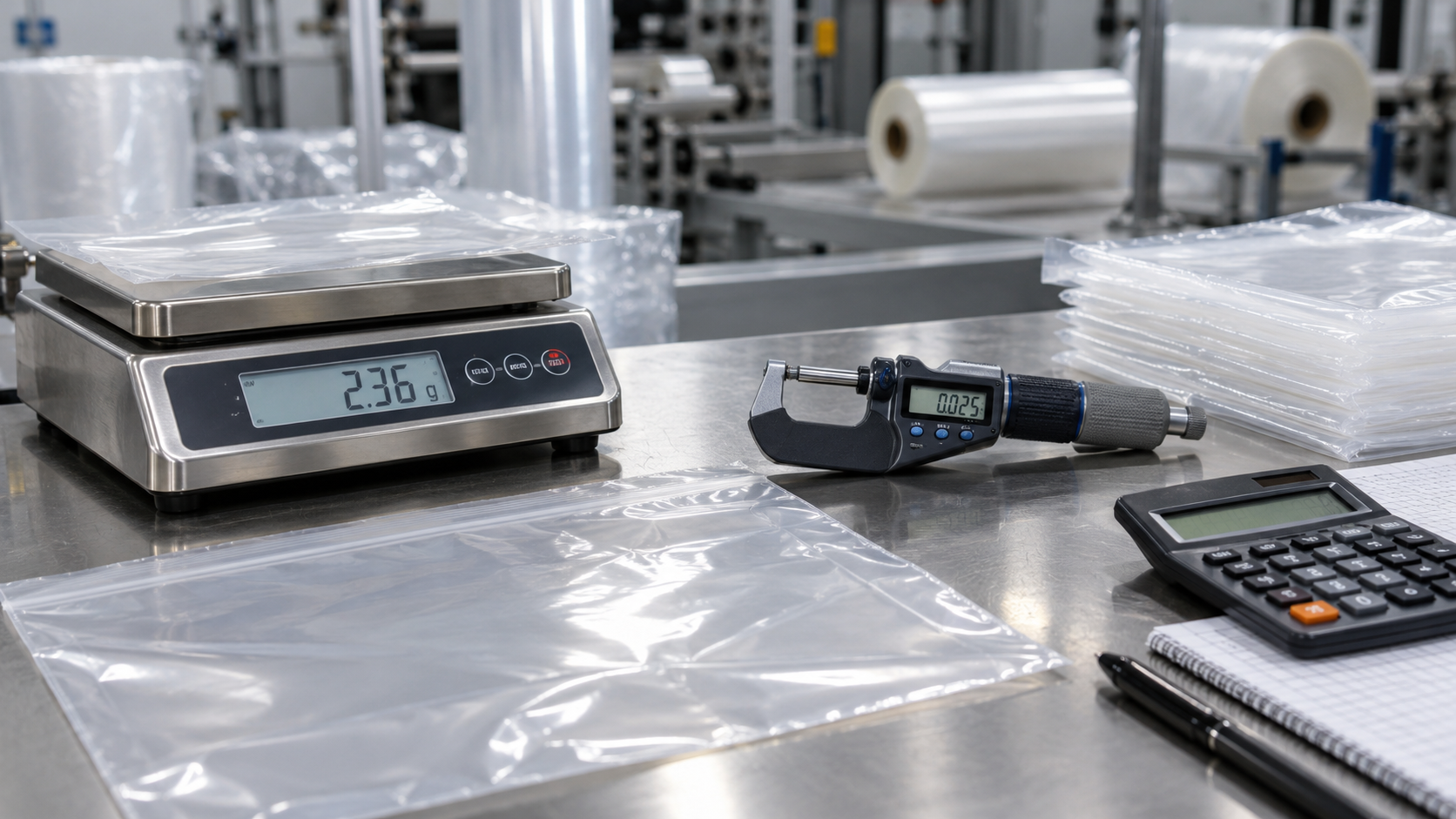
Industrial plastic is often quoted by the kilogram while production teams think in pieces, rolls, or individual bag dimensions. Understanding how to calculate PE plastic weight allows buyers to check whether the quoted dimensions, micron thickness, and expected quantity are consistent.
The basic calculation is straightforward. You need the film dimensions, thickness, number of film layers, and the density of the actual material. The theoretical result should still be checked against production weight because blown film has gauge tolerances and formulations vary by resin grade.
What Information Do You Need?
Prepare the following information:
- Film or bag width
- Length
- Thickness in microns (µm)
- Number of film layers being calculated
- Material density
- Required quantity
For accurate work, density should come from the actual resin or formulation data. HDPE, LDPE, and LLDPE do not have identical densities, and individual grades within one polymer family can also differ.
The Basic PE Film Weight Formula
Using metric units:
Weight (kg) = Width (m) × Length (m) × Thickness (m) × Density (kg/m³) × Number of Layers
One micron equals 0.000001 metre, so micron thickness must first be converted into metres.
For a single flat sheet, use one layer. For a finished bag calculated from its front and back surfaces, use two layers. Lay-flat tubing is also represented by two film surfaces.
Example: Calculating the Weight of a PE Bag
Consider a bag measuring 50 cm × 80 cm at 60 microns. For illustration only, assume the material density is 920 kg/m³.
0.50 × 0.80 × 60 × 10-6 × 920 × 2 = 0.04416 kg
The theoretical weight is approximately 44.2 grams per bag.
For 10,000 bags, the theoretical finished-film weight would therefore be approximately 442 kg before considering items outside the net plastic weight such as trimming, packaging, cores, or other production losses.
How Should Gusseted Bags Be Calculated?
A gusseted bag uses additional film that is folded into the sides or bottom. Calculating only the visible front width will underestimate the amount of material.
The preferred approach is to use the developed film width: the total width of film before it is folded into the gusset configuration. This depends on whether the product uses side gussets, a bottom gusset, or another construction. When only finished dimensions are provided, buyers should confirm the supplier's basis for calculating film area.
Why Can Actual Weight Differ?
The formula produces a theoretical weight. Actual bag weight can vary because of:
- Gauge variation across and along the film
- Differences in formulation density
- Width and length tolerances
- Gussets, folds, and seal construction
- Sampling and weighing accuracy
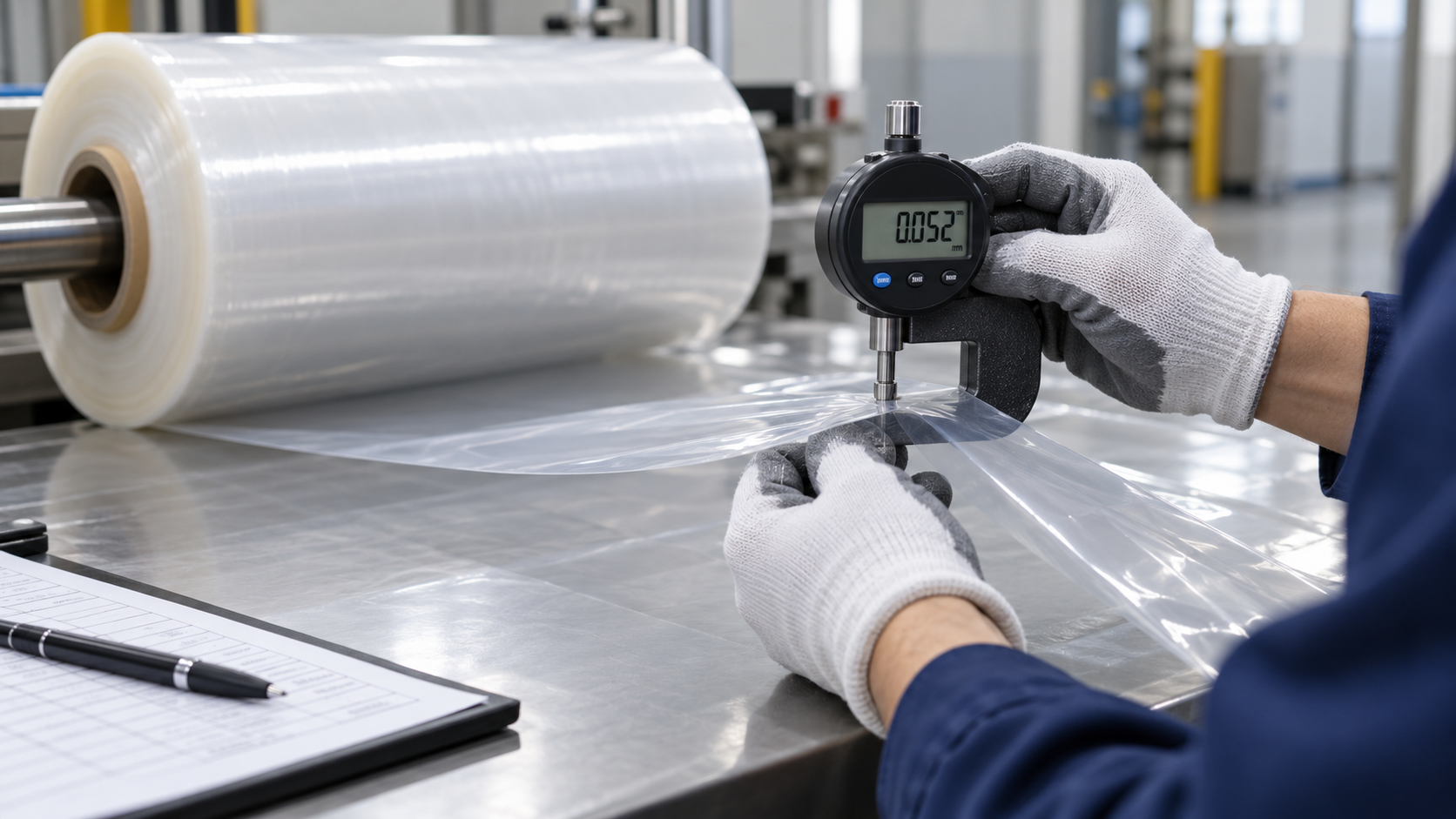
ASTM D8136 specifically addresses film thickness and thickness variability in both machine and transverse directions for quality control and buyer-seller communication. A nominal 60-micron film therefore does not mean every point is exactly 60 microns.
How Can Buyers Use This Calculation?
Theoretical weight provides a useful quotation check. If two suppliers quote the same bag dimensions and nominal thickness but their weight per thousand pieces differs significantly, the buyer can investigate density, gauge tolerance, dimensions, or the definition of thickness being used.
The same calculation also allows procurement teams to convert price per kilogram into an estimated price per piece, forecast resin demand, and plan inventory.
Related Reading
- What Does Micron Mean in Plastic Film? A Buyer’s Thickness Guide
- How Many PE Plastic Bags Are There in 1 Kilogram?
- Product Specification
Conclusion
PE film weight is primarily determined by film area, micron thickness, density, and the number of layers. The calculation is useful for procurement and costing, but production weight should still be verified on the finished product.
For more context, Dynaplast's guides to plastic film micron thickness and PE film thickness by application explain how gauge affects packaging specifications. PT Dynaplast Mandiri can also evaluate dimensions, polymer selection, thickness, and target bag weight before the production specification is finalized.