Terjemahan
When purchasing plastic packaging for direct food contact, buyers often begin with one question: “Is this plastic food grade?”
That is important, but it is not always sufficient.
A finished package may contain polymers, additives, processing aids, pigments, adhesives, coatings, or other substances. Under certain conditions, some substances can transfer from the packaging into food. This process is known as migration.
Indonesia’s BPOM Regulation No. 11 of 2026 on Food Packaging strengthens food-contact safety requirements, including migration limits. The regulation is currently in force and replaced BPOM Regulation No. 20 of 2019.
What Is Food Packaging Migration Testing?
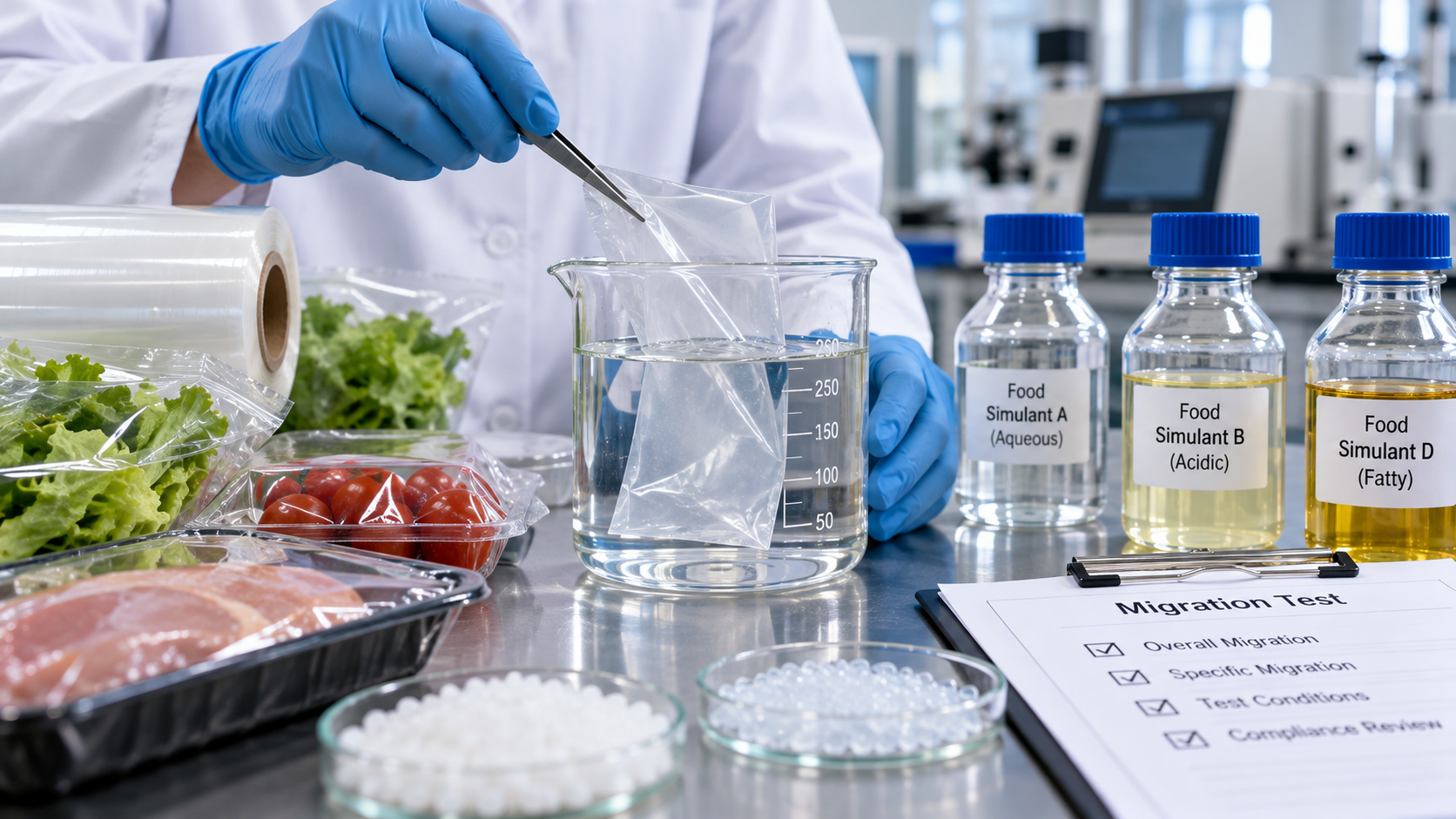
Migration testing evaluates the transfer of substances from a food-contact material into food or into a test medium that represents food under defined conditions.
BPOM distinguishes two important concepts:
Overall migration measures the total amount of substances transferred from the packaging.
Specific migration measures the transfer of a particular substance for which a specific safety limit or concern has been established.
This means a single test does not necessarily answer every food-packaging safety question. The packaging material and its composition determine which requirements may be relevant.
Why Does the Type of Food Matter?
Migration behavior depends on more than the polymer.
Water-based, acidic, fatty, and alcoholic foods can interact differently with packaging materials.
Testing every actual food product is not always practical. Laboratories may therefore use food simulants selected to represent particular food categories.
This approach is also used internationally. FDA migration guidance recommends selecting simulants according to food type and testing under time and temperature conditions that represent the intended application.
Contact Time and Temperature Matter
A bag used for frozen food experiences very different conditions from packaging used for hot filling or reheating.
Before testing or specifying packaging, buyers should therefore define:
- Food type
- Whether the food is fatty or oily
- Filling temperature
- Storage temperature
- Contact duration
- Whether the food is heated in the package
- Whether the packaging is single-use or reusable
Migration testing should reflect the intended conditions rather than applying one generic test to every packaging application.
Does Food-Grade Resin Automatically Mean the Finished Bag Is Compliant?
Not necessarily.
A resin manufacturer’s compliance statement can be an important starting document, but the finished package may contain additional additives, masterbatch, inks, adhesives, coatings, or other materials.
BPOM states that only food-contact substances evaluated as safe may be used in food packaging. The 2026 regulation also expanded the range of regulated plastic packaging materials and the list of permitted food-contact substances.
For buyers, this means the finished packaging construction and intended use matter—not only the base polymer name.
What Should Buyers Request from Packaging Suppliers?
1. Clear Material Identification
Know the polymer and packaging structure being supplied, for example a PE monolayer film or another construction.
2. Intended-Use Information
Tell the supplier whether the package will contact dry food, frozen products, fatty foods, hot-filled products, or other conditions.
3. Additive Information
Where relevant, verify that additives, colorants, and treatments are appropriate for the intended food-contact application.
4. Relevant Migration Test Reports
Review:
- Material tested
- Parameters tested
- Test method
- Contact conditions
- Test date
- Result and applicable limit
Previous BPOM registration guidance also showed that migration test reports could, for certain registration requirements, be submitted either by the food business or sourced from its packaging supplier.
5. Confirm the Tested Sample Represents the Actual Package
A migration report is more meaningful when the tested material has the same relevant formulation, structure, gauge, and intended use as the packaging being purchased.
Does Every Bag Size Require a New Test?
Bag dimensions alone should not automatically determine whether retesting is necessary.
A more important question is whether changes affect the:
- Polymer
- Formulation
- Layer structure
- Additives
- Film thickness
- Printing or coating
- Intended food-contact conditions
When a meaningful change occurs, buyers should consult their packaging supplier, regulatory team, or testing laboratory to determine whether additional evaluation is appropriate.
What Changed Under BPOM Regulation No. 11 of 2026?
The new regulation does more than establish migration requirements.
BPOM reports that the number of regulated plastic material types increased from 41 to 58, while 88 additional permitted food-contact substances were added following safety evaluation. Requirements for reusable and recycled food packaging were also clarified.
This makes traceability of materials and intended use increasingly important.
Conclusion
Food packaging migration testing helps determine whether substances transferring from packaging remain within applicable safety requirements under the intended conditions of use.
Industrial buyers should therefore look beyond a simple “food-grade” label and evaluate polymer type, additives, packaging structure, food type, contact time, temperature, and relevant migration documentation.
PT Dynaplast Mandiri supplies PE films and bags to multiple industries, including food and beverage applications. For food-contact packaging, the intended food and operating conditions should be communicated early so the appropriate material specification and documentation requirements can be evaluated.