Terjemahan

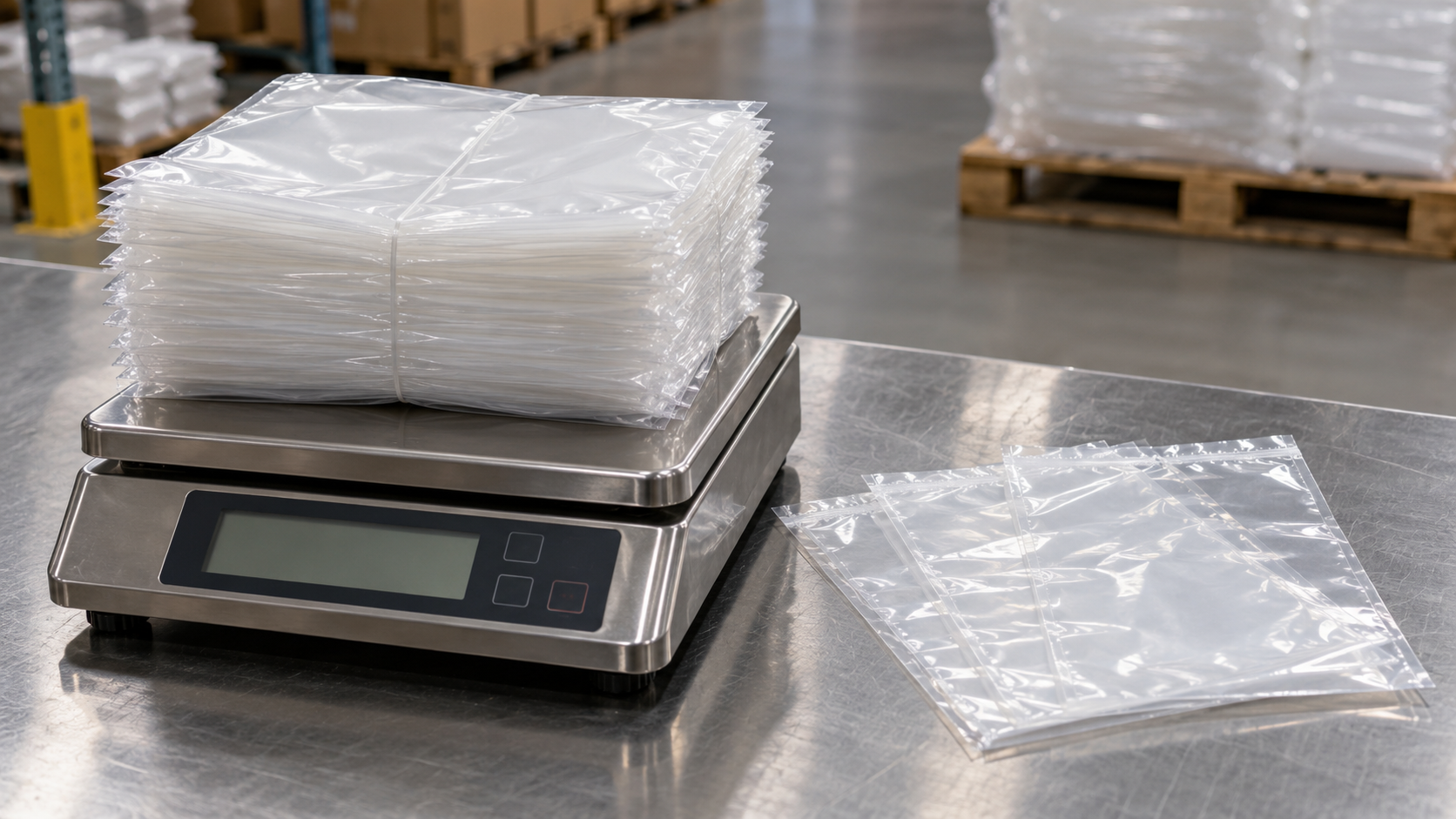
Industrial plastic suppliers commonly quote by weight, while purchasing and production teams often need to know how many usable bags they will receive. This makes how many PE bags are in one kilogram an important question when comparing quotations.
There is no fixed answer based only on the polymer type. Pieces per kilogram depend on bag dimensions, film thickness, material density, gussets, and the construction of the finished bag.
The Simplest Formula
If the weight of one finished bag is already known:
Pieces per kg = 1,000 grams ÷ weight of one bag in grams
For example, if one bag weighs 25 grams:
1,000 ÷ 25 = 40 bags/kg
If one bag weighs 50 grams, one kilogram contains approximately 20 bags.
This is why buyers should request either weight per piece or weight per thousand pieces when checking a supplier quotation.
What If the Bag Weight Is Not Known?
Theoretical weight can be calculated from the film dimensions:
Weight = Film area × thickness × density
A flat bag without gussets has two film surfaces, front and back, so the area of one face is multiplied by two.
Consider a 40 cm × 60 cm bag at 50 microns. For illustration, use a density of 920 kg/m³:
0.40 × 0.60 × 50 × 10-6 × 920 × 2
The theoretical weight is approximately 22.1 grams per bag. The theoretical yield is therefore:
1,000 ÷ 22.1 ≈ 45 bags/kg
The density value is only an example. A real quotation should use the density of the actual material formulation.
Why Can Bags of the Same Size Have Different Pieces per Kilogram?
Two bags with identical width and length can still have different yields because:
- Film thickness differs. Higher gauge increases weight per piece.
- The polymer or formulation differs. HDPE, LDPE, and LLDPE have different densities and film behavior.
- There is a gusset. Side or bottom folds add film area.
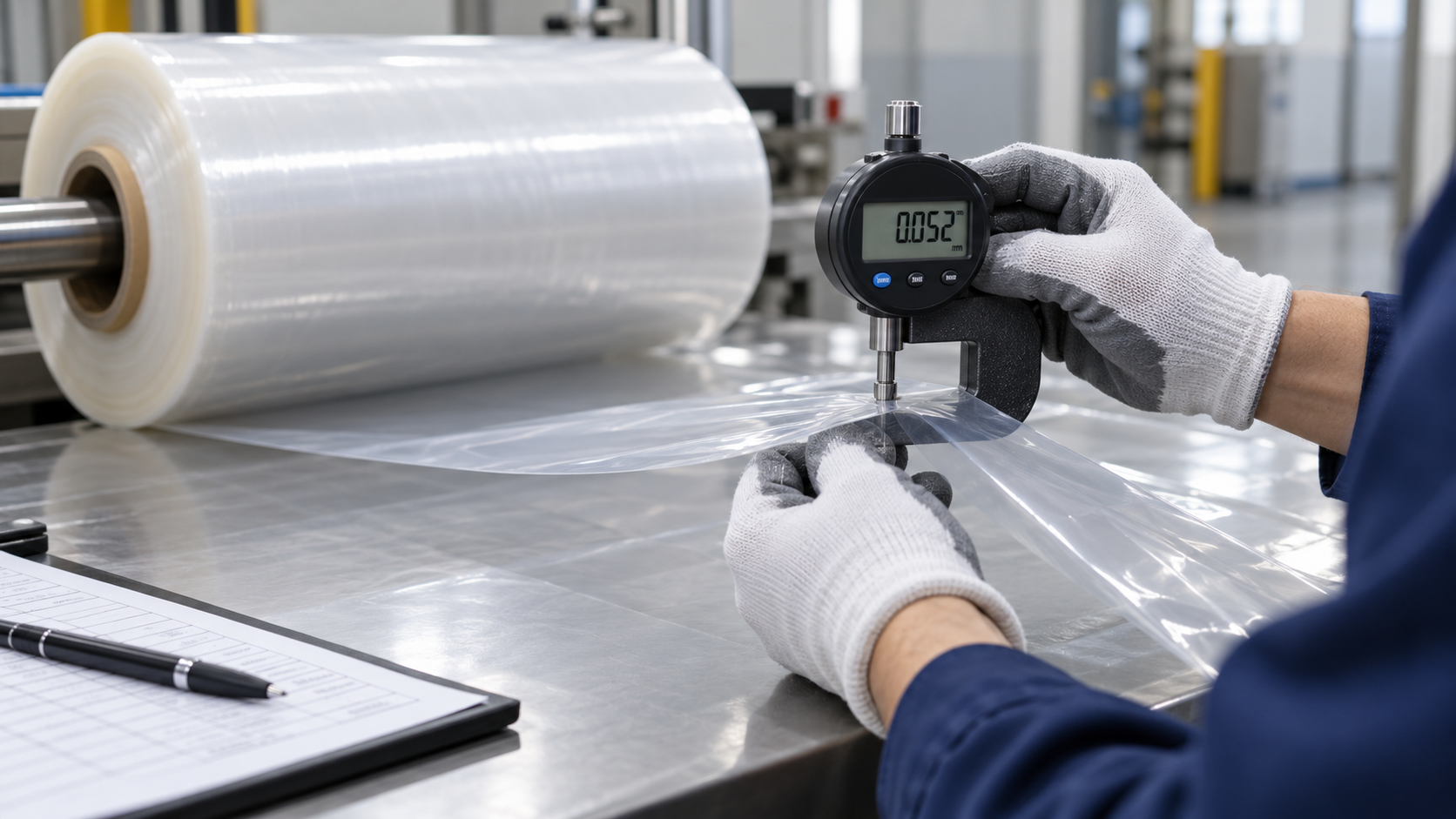
- Gauge tolerance exists. Nominal micron is a target rather than an identical measurement at every point.
- Actual dimensions vary. Small dimensional differences become significant across large quantities.
How Does Micron Thickness Affect Bags per Kilogram?
With all other factors unchanged, increasing film thickness reduces the number of bags obtained from one kilogram.
For example, moving from 50 microns to 100 microns theoretically doubles the material volume per unit area. Bag weight would be approximately twice as high and pieces per kilogram approximately half as many, assuming dimensions and density remain unchanged.
However, buyers should not reduce gauge simply to obtain more pieces per kilogram. Thickness must still be suitable for product weight, puncture risk, seal strength, handling, and the overall packaging application.
Why Price per Kilogram Alone Can Be Misleading
Supplier A may offer a lower price per kilogram, but if its finished bags are heavier than Supplier B's specification, the cost per piece may not actually be lower.
A fair quotation comparison should review:
- Actual dimensions
- Nominal thickness and tolerance
- Polymer type
- Weight per piece
- Pieces per kilogram
- Price per kilogram and estimated price per piece
For packaging consumed by count, cost per usable bag may be more relevant than resin price per kilogram alone.
Verify the Calculation With Actual Samples
Theoretical calculations are useful for checking, but actual production samples should be weighed before a final purchasing specification is approved.
For lightweight bags, weigh a group such as 20 or 50 pieces and divide the total by the sample count. This often produces a more stable result than trying to weigh one very light bag.
ASTM D8136 also recognizes thickness variability as an important characteristic of plastic film, which is one reason actual bag weight can differ from a purely theoretical figure.
Related Reading
- How to Calculate PE Plastic Weight from Dimensions, Microns, and Quantity
- What Does Micron Mean in Plastic Film? A Buyer’s Thickness Guide
- Product Specification
Conclusion
The simplest way to determine bags per kilogram is to divide 1,000 grams by the actual weight of one finished bag.
If bag weight is not yet available, estimate it from dimensions, micron thickness, density, number of layers, and gusset construction, then verify the result with production samples.
Dynaplast's guides to film micron thickness and PE film thickness by application provide additional context before comparing packaging on either a kilogram or per-piece basis.