Terjemahan

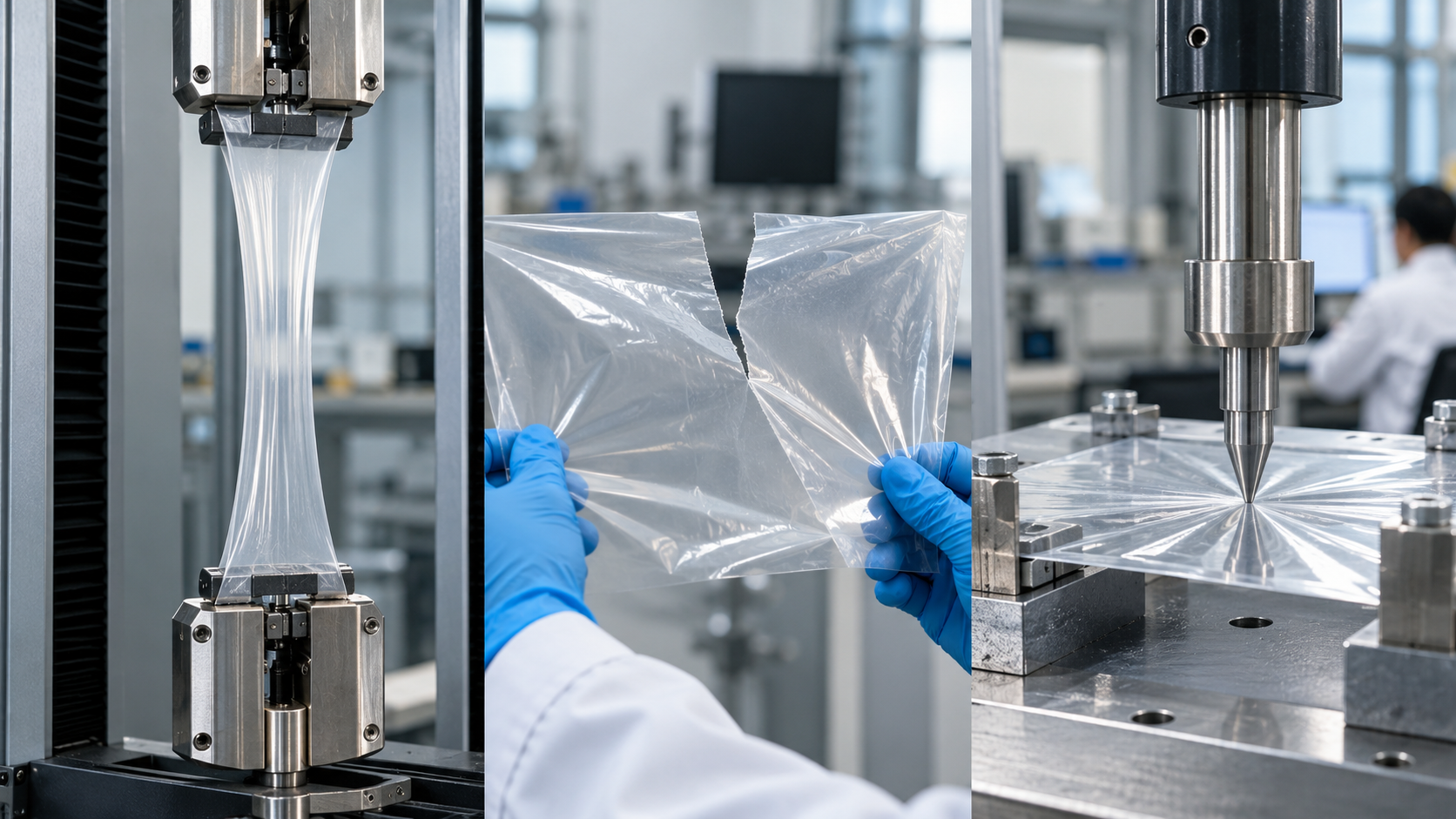
Plastic film data sheets often contain values for tensile strength, tear strength, puncture resistance, elongation, and dart impact. They can all look like measurements of “strength,” but each describes a different failure mechanism.
This distinction matters because a film with high tensile strength is not automatically the best choice for sharp-edged components. Likewise, good puncture resistance does not necessarily mean a film has the highest tear-propagation resistance once it has already been cut.
What Is Tensile Strength?
Tensile strength describes how a material responds when it is pulled in tension until yield or break.
ASTM D882 is widely used to determine tensile properties of thin plastic films and sheeting. Film data are commonly reported in the machine direction (MD) and transverse direction (TD).
Tensile properties matter when film is stretched by the product, subjected to tension during converting, or pulled during handling.
However, a tensile test uses a defined specimen geometry. It does not directly reproduce what happens when a bolt, gear tooth, or sharp metal corner presses into a bag.
What Is Elongation at Break?
Elongation is often reported together with tensile strength.
It indicates how far the specimen can stretch before breaking, normally expressed as a percentage of its original gauge length. A film with high elongation can deform significantly before failure, but elongation by itself does not describe puncture or tear resistance.
What Is Tear Strength?
Tear strength describes resistance to tearing.
An important distinction is the difference between initiating damage and tear propagation: how easily an existing cut continues to grow.
ASTM D1922 is one commonly used method for measuring propagation tear resistance using an Elmendorf-type approach.
MD and TD tear values can differ substantially because blown film becomes oriented during extrusion. Buyers should therefore avoid comparing a single tear number without knowing the test direction.
What Is Puncture Resistance?
Puncture resistance addresses a different question: how well does the film resist a localized object or shape penetrating its surface?
This is particularly relevant for:
- Gears and bearings
- Metal brackets
- Bolts and fasteners
- Automotive components
- Products with sharp corners
ASTM D7192 is one test method used to characterize high-speed puncture properties of plastic films, while other puncture methods may be selected according to the application.
Puncture behavior depends on polymer grade, formulation, thickness, temperature, and film processing, so two films of the same nominal gauge can perform differently.
What About Dart Impact?
Dart impact measures how well a film withstands impact from a falling dart under specified conditions. ASTM D1709 is widely used for plastic film.
Dart impact is not the same as a puncture test even though both involve localized loading. The impactor geometry, speed, and evaluation method differ.
Practical Comparison
| Property | What Does It Tell You? | Example Risk |
|---|---|---|
| Tensile Strength | How much tensile load can the film withstand? | Film being stretched or pulled |
| Elongation | How far can the film stretch? | Conforming around a product |
| Tear Strength | How resistant is an existing tear to propagation? | A nick becoming a large tear |
| Puncture Resistance | How well does the film resist local penetration? | A gear tooth or bracket corner pressing through film |
| Dart Impact | How well does the film withstand sudden impact? | Localized impact on the package |
Which Property Should a Buyer Prioritize?
There is no single property that is always most important.
For a smooth but heavy product, tensile and seal strength may matter more. For sharp spare parts, puncture and tear behavior become critical. For a bag that needs to conform around the product, elongation and overall toughness are also relevant.
The correct starting point is the most likely failure mode in the actual application.
Do Not Compare Numbers Without Test Conditions
Technical values should only be compared when test method, specimen gauge, temperature, and other conditions are reasonably comparable.
ASTM maintains separate methods for tensile, tear, puncture, impact, and thickness because these properties describe different material responses.
Related Reading
- Why Does PE Plastic Tear Easily? 7 Causes to Check
- PE Film Thickness Guide by Application
- Product Specification
Conclusion
Puncture resistance, tear strength, and tensile strength are not interchangeable measurements. Tensile describes pulling behavior, tear describes tear propagation, and puncture describes resistance to localized penetration.
Industrial film specifications should therefore be based on the product's actual risks rather than simply selecting the material with the highest value on one data-sheet line. Dynaplast's guides to film thickness by application and HDPE, LDPE, and LLDPE provide useful supporting context.