Terjemahan
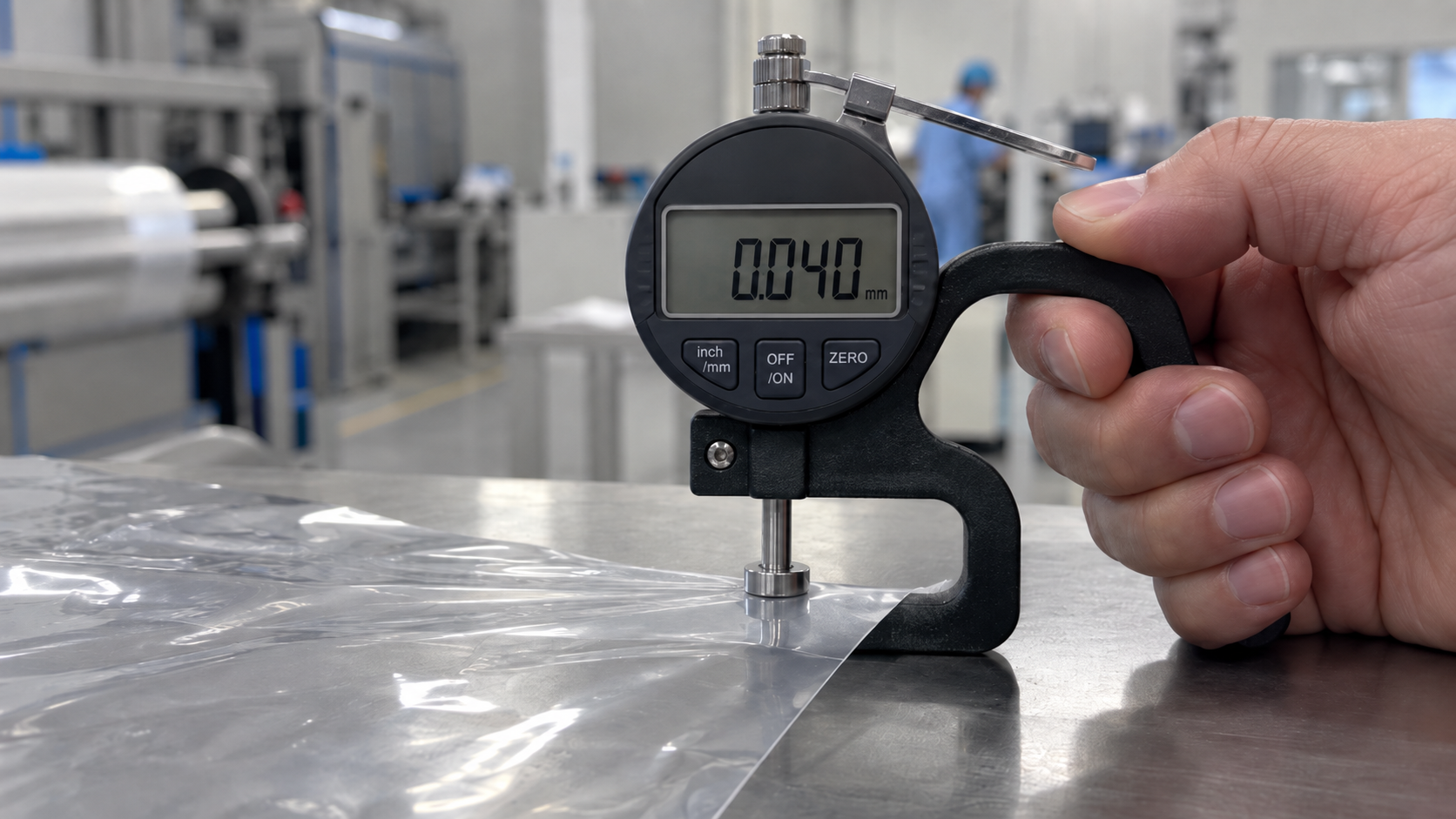
When purchasing polyethylene film or bags, one specification appears repeatedly: micron. Values such as 30, 50, 100, or 150 microns describe the thickness of the plastic film.
For industrial buyers, this number matters because thickness influences material usage, product weight, cost per bag or sheet, and packaging performance.
What Is a Micron?
A micron, or micrometer (µm), is a very small unit of length.
1 micron = 0.001 mm
For example:
| Microns | Thickness in mm |
|---|---|
| 30 µm | 0.030 mm |
| 50 µm | 0.050 mm |
| 75 µm | 0.075 mm |
| 100 µm | 0.100 mm |
| 150 µm | 0.150 mm |
Because plastic films are very thin, microns are more practical than millimeters when specifying packaging.
ISO 4593 provides a method for measuring plastic film thickness by mechanical scanning, while ASTM D6988 provides current guidance for determining the thickness of plastic film test specimens.
Does a Higher Micron Mean Stronger Plastic?
If the polymer, formulation, dimensions, and processing are identical, increasing film thickness generally means more material is present and can increase mechanical durability.
However, thickness alone does not determine film performance.
Two 50-micron films can perform differently because of resin grade, polymer family, blends, additives, extrusion conditions, film orientation, and seal quality.
Technical polyethylene data sheets therefore report properties such as puncture resistance, tensile strength, elongation, and tear strength at specified film gauges. A current Dow LLDPE data sheet, for example, reports different mechanical tests at film thicknesses of approximately 25 and 38 microns.
How Does Micron Affect Cost?
For the same material and film dimensions, increasing thickness increases the amount of resin required.
In simple terms, a 100-micron film contains approximately twice the material volume per unit area of a 50-micron film, assuming the same density and construction.
This is why industrial buyers should be careful when comparing quotations only by price per piece. Two bags with identical width and length may have different weights and costs because their thicknesses are different.
How Many Microns Do You Need?
There is no universal thickness suitable for every packaging application.
The correct gauge depends on factors such as:
- Product weight
- Product dimensions and geometry
- Sharp edges
- Puncture and tear risk
- PE material and formulation
- Sealing process
- Handling and stacking
- Storage and transportation conditions
A lightweight product with smooth surfaces does not create the same packaging requirement as a heavy machined component with sharp corners.
Dynaplast Mandiri’s current product specifications include multiple PE materials and thickness ranges, with dimensions and colors customizable according to customer requirements.
How Is Plastic Film Thickness Checked?
Film thickness can be measured using a film thickness gauge or micrometer at multiple points across the sample.
For more detailed quality control, manufacturers can also monitor thickness variability across the machine and transverse directions. ASTM D8136 specifically addresses film thickness and thickness variability for production control, inspection, and communication between film buyers and sellers.
Dynaplast Mandiri states that its production quality checks monitor parameters including material composition, film thickness, and dimensional accuracy.
Conclusion
Micron describes plastic film thickness, but film quality should never be judged by thickness alone.
Industrial buyers should select thickness together with the polymer type, product dimensions, weight, puncture risk, packing process, and distribution conditions.
Using more microns than necessary can increase material consumption and unit weight, while insufficient thickness may compromise packaging performance.
If the appropriate film gauge is unclear, PT Dynaplast Mandiri can evaluate the application and help determine a suitable combination of material, dimensions, and thickness before the final quotation is prepared.