Terjemahan

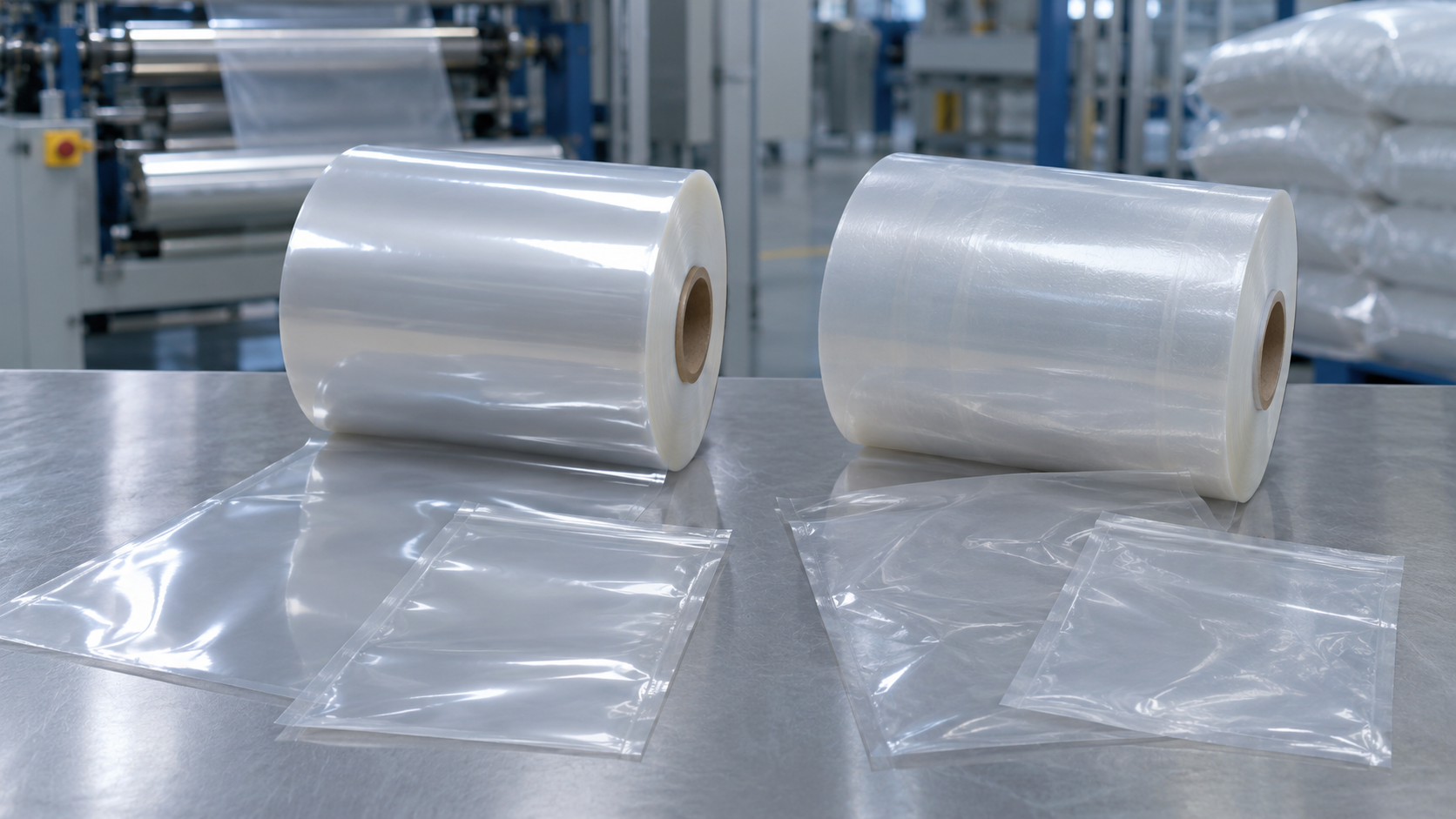
Industrial film buyers may encounter terms such as metallocene PE, mPE, or mLLDPE. These materials are often associated with toughness, puncture resistance, sealing, or film downgauging. However, “metallocene” does not describe one universal resin that is automatically better than conventional LLDPE in every property.
The main distinction is the catalyst system and the level of control over polymer structure. Final performance still depends on grade, density, comonomer, melt index, formulation, and film processing.
What Is Metallocene Polyethylene?
Metallocene polyethylene is produced using a catalyst platform that can provide more precise control of molecular architecture than many conventional catalyst systems.
In film packaging, the term mLLDPE is commonly used for linear low-density polyethylene produced using a metallocene catalyst.
Resin suppliers offer many different mPE grades, so buyers should review the technical data sheet for the actual grade rather than assuming every metallocene resin has the same characteristics.
How Is It Different from Conventional LLDPE?
Conventional LLDPE and mLLDPE can both be used in blown film. The distinction is not simply density.
Depending on the catalyst, molecular distribution, comonomer, and grade design, some mPE products can offer useful combinations of:
- High toughness
- Puncture resistance
- Dart impact performance
- Sealability
- Optical properties
- Potential downgauging in validated structures
These are grade-specific characteristics. Conventional LLDPE can be an excellent choice for many applications, while a particular mPE may be optimized for a different performance target.
Why Is Metallocene PE Often Considered for Puncture?
Packaging for irregular or relatively sharp products needs film that can deform and absorb energy before failure.
Several metallocene-based performance polyethylene families are specifically designed around puncture, dart impact, and toughness. ExxonMobil, for example, lists Exceed performance PE grades for applications such as heavy-duty bags, liners, and flexible packaging, together with measured puncture and dart properties.
Dow also offers enhanced polyethylene grades for blown film that combine tensile, tear, puncture, and sealing performance.
This is why mPE can become one formulation option when a standard film does not provide enough durability.
Can Metallocene Allow Thinner Film?
In some properly tested structures, high-performance resin can support downgauging: reducing film thickness while retaining a required level of package performance.
This should never be assumed automatically.
Replacing an 80-micron film with a 60-micron film simply because the new formulation contains mPE can change puncture resistance, seal performance, stiffness, handling, and bag-drop behavior.
Any downgauging program should be validated using the actual product, packing process, and distribution conditions.
What About Seal Performance?
Some metallocene or enhanced PE grades are designed with relatively low seal-initiation temperatures and high seal performance.
This can be useful on form-fill-seal and higher-speed packaging equipment where the available sealing window affects productivity.
Final seal performance still depends on temperature, pressure, dwell time, contamination, film thickness, and the complete formulation. A high-performance resin cannot compensate for a damaged sealing bar or a contaminated seal area.
Does the Film Need to Be 100% Metallocene PE?
No.
In many film applications, performance resin is used as part of a blend with LLDPE, LDPE, or other PE grades. The objective is to balance film performance with processing behavior and the application requirement.
The appropriate blend depends on targets such as:
- Puncture and tear resistance
- Stiffness
- Clarity
- Seal behavior
- Line stability
- Target gauge
When Should Buyers Consider mPE?
Metallocene PE may be worth evaluating when:
- A film continues to puncture despite reasonable thickness
- The customer wants to explore controlled downgauging
- Low-temperature toughness is important
- A packaging line requires particular sealing performance
- The application needs a balance of toughness and optical properties
Sample trials remain important before any mass-production specification is changed.
Related Reading
- HDPE vs LDPE vs LLDPE: Choosing the Right PE for Industrial Packaging
- Puncture Resistance vs Tear Strength vs Tensile Strength: What Is the Difference?
- PE Film Thickness Guide by Application
Conclusion
Metallocene PE is not simply “stronger LLDPE.” It is a family of performance polyethylene materials created using a catalyst platform that enables different polymer structures and a wide range of grades.
Depending on the grade, mPE can provide attractive combinations of puncture resistance, toughness, impact performance, optics, and sealing. The benefit must still be assessed against the actual formulation, thickness, and application.
PT Dynaplast Mandiri can evaluate metallocene-containing PE film for selected industrial applications. For material-selection fundamentals, see the guides to HDPE, LDPE, and LLDPE and film thickness by application.