Terjemahan

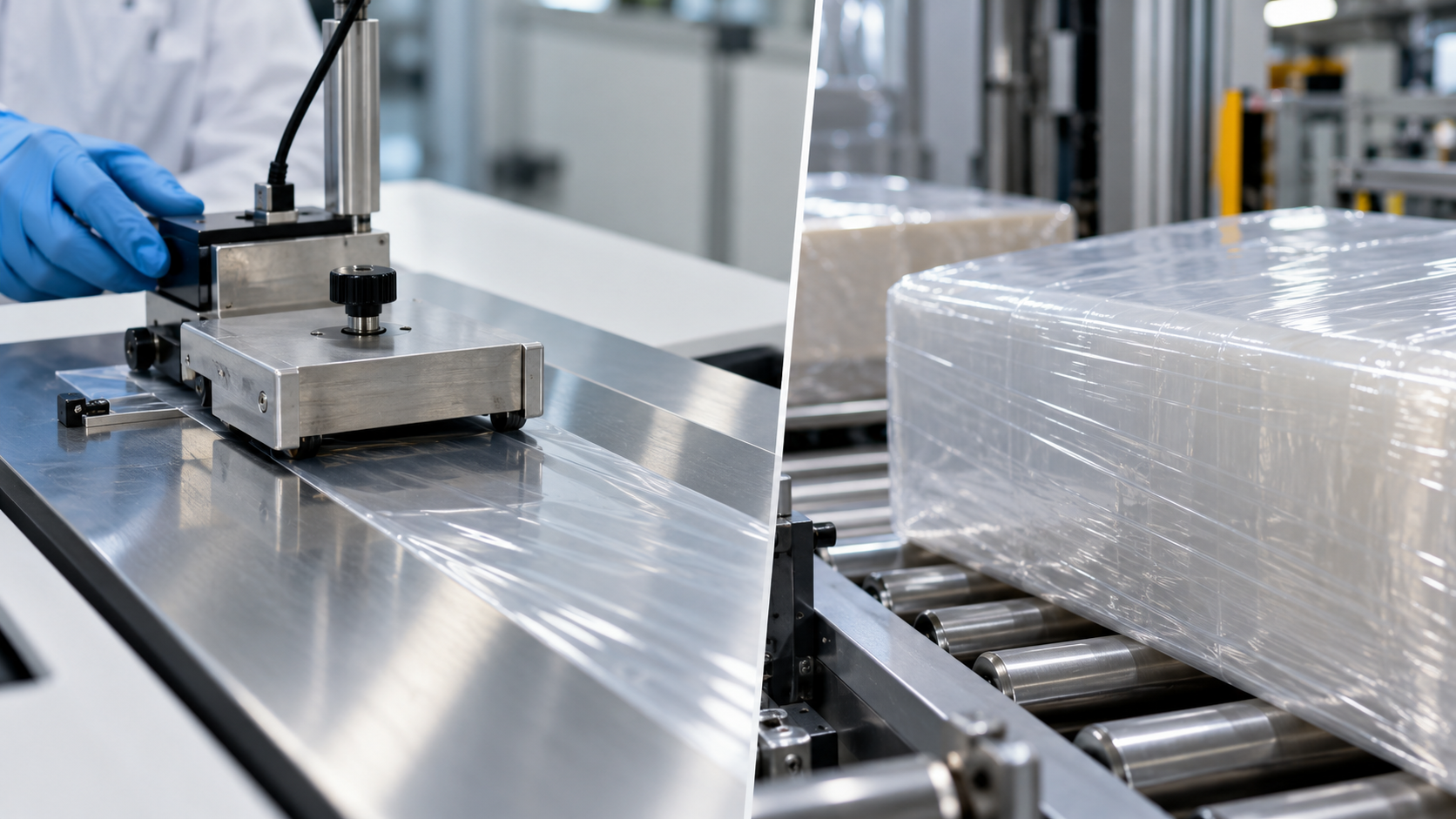
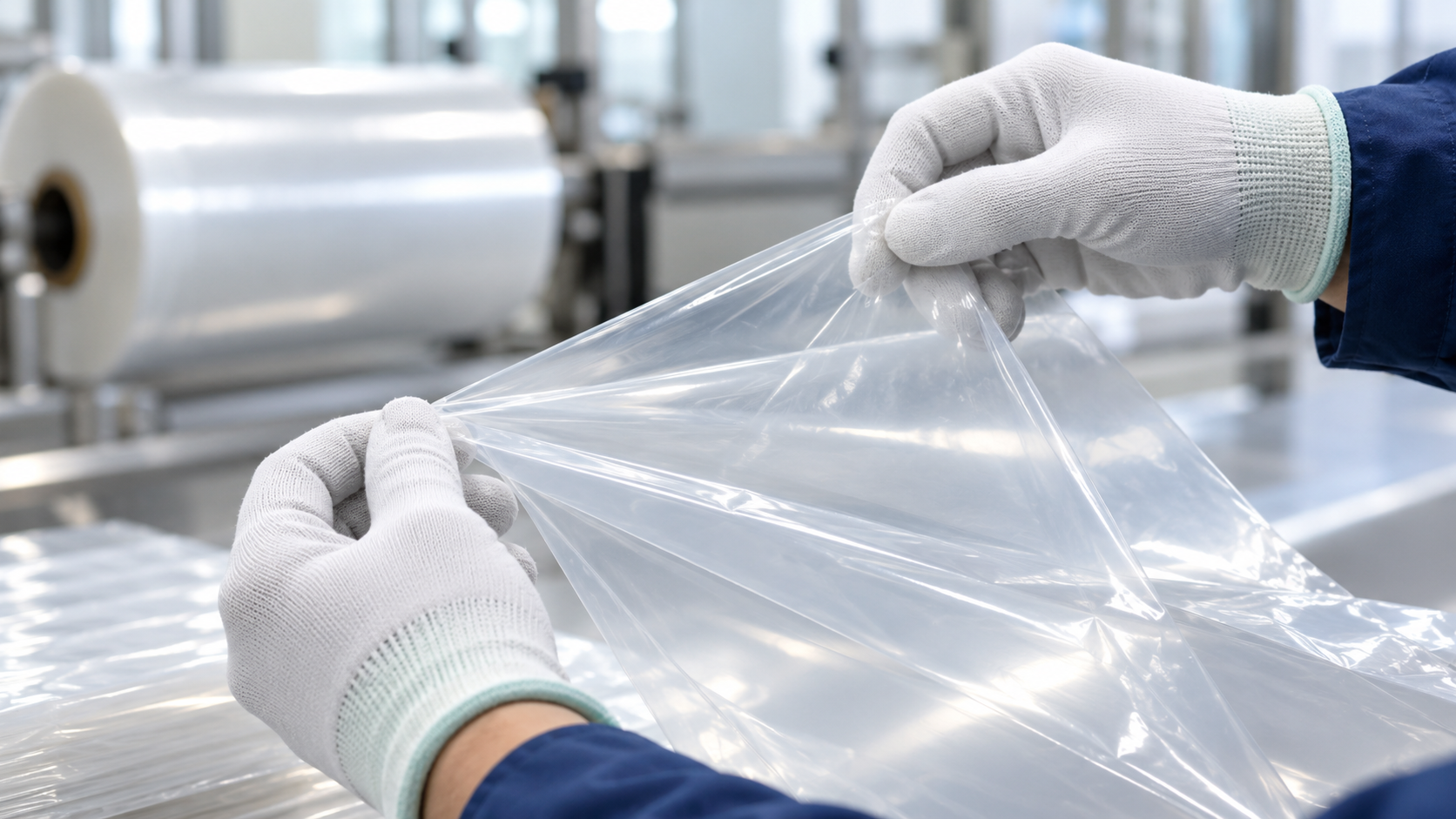
PE film can create two opposite handling problems: it may feel too grippy and resist movement through packaging equipment, or it may become so slippery that stacked bags and products shift too easily. One of the main properties associated with this behavior is the coefficient of friction (COF).
COF and slip matter because they affect how film moves against itself, metal guides, forming collars, conveyors, and other surfaces during packing and converting.
What Is Coefficient of Friction?
COF is the ratio between frictional force and the normal force pressing two surfaces together.
In practical terms:
- Higher COF means the surfaces resist sliding and feel more “grippy.”
- Lower COF means the film slides more easily and feels more “slippery.”
ASTM D1894 is a standard test method for measuring static and kinetic coefficients of friction for plastic film and sheeting.
Static COF vs Kinetic COF
Static COF relates to the force required to start movement.
Kinetic COF describes resistance after the surfaces are already sliding.
Both can matter in packaging. A bag may require excessive force to start opening because static friction is high, even though the surfaces slide more easily once movement begins.
What Is a Slip Additive?
Film manufacturers can use slip additives to control surface friction.
In many polyethylene films, certain additives migrate or “bloom” toward the surface after extrusion, forming a very thin lubricating layer that lowers friction.
ASTM D1894 notes that slip additives in polyethylene can migrate to the surface and that this blooming behavior can be time-dependent. Therefore, the COF of freshly produced film may not be identical to the COF after several days of storage.
Why Is Film That Is Too Grippy a Problem?
Excessively high COF can lead to:
- Bags that are difficult to open individually
- Film dragging through guides or forming equipment
- Wrinkles during converting
- Reduced packaging-line speed
- Difficult manual sliding or positioning
On automatic lines, relatively small changes in surface friction can affect feeding consistency and web handling.
Why Can Film Be Too Slippery?
A very low COF is not automatically better.
Film that is too slippery may cause:
- Bags or sacks to shift during stacking
- Poor stability on certain conveyors
- More sensitive roll handling or winding behavior
- Difficulty for operators trying to hold or position the film
The appropriate COF therefore depends on the intended operation rather than a goal of making the film as slippery as possible.
Slip Is Not the Same as Anti-Block
Slip and anti-block are often discussed together but perform different functions.
Slip primarily controls friction when two surfaces move across each other. Anti-block helps prevent adjacent film layers from adhering too strongly when they remain in contact during winding or storage.
A film can have both friction and blocking issues, but the formulation approach is not necessarily the same.
What Else Can Affect COF?
Surface friction can also be influenced by:
- Resin and formulation
- Slip-additive type and level
- Time after extrusion
- Storage temperature
- Corona or other surface treatment
- Surface contamination
- Printing and coating
Because some slip additives continue to migrate after production, buyers should consider the age of the sample at testing relative to the age of the film when it will actually be used.
How Should a Buyer Specify COF Requirements?
If surface friction is important to a customer line, avoid specifying only “add slip.” Describe the application:
- Manual or automatic packing?
- Film-to-film or film-to-metal movement?
- Do bags need to open easily?
- Must stacked packages remain stable?
- How long after production will the film be used?
If a numerical COF target is required, define whether it is static or kinetic, the test method, the side of the film being tested, and the conditioning or aging period.
Related Reading
- What Is Anti-Block in PE Film? Why Plastic Bags Can Stick Together
- PE Film Thickness Tolerance: Why Micron Is Not Identical Everywhere
- Product Specification
Conclusion
Slip and COF describe how PE film moves and interacts with other surfaces. COF that is too high can make film difficult to process, while COF that is too low can make packages excessively slippery and unstable.
The correct target depends on the packing process and end use. PT Dynaplast Mandiri can evaluate functional film requirements together with polymer selection, thickness, and additives rather than treating each property in isolation.
For material fundamentals, see Dynaplast's guide to HDPE, LDPE, and LLDPE.