Terjemahan
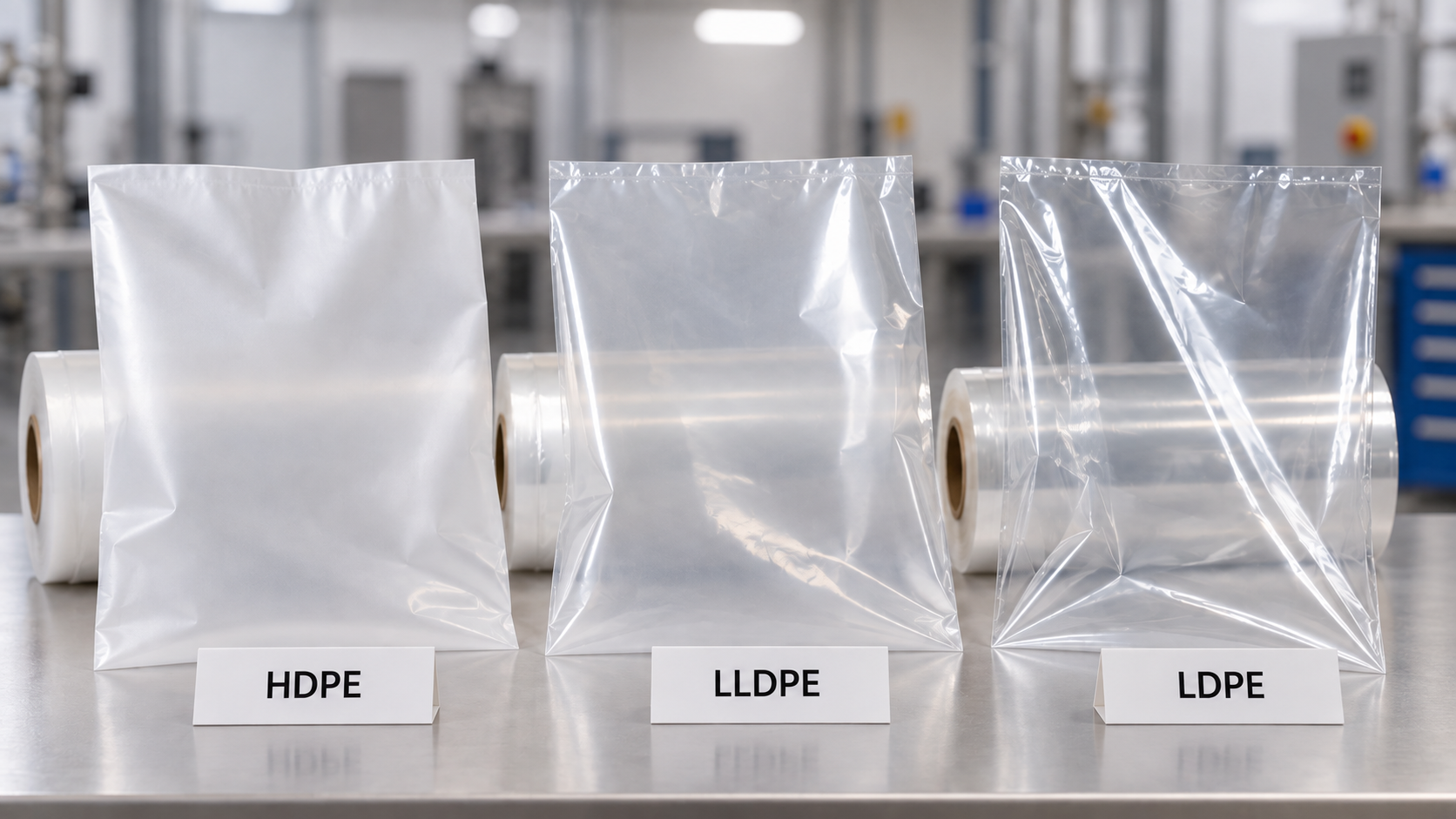
HDPE vs LDPE vs LLDPE: Which Is Right for Your Application?
HDPE, LDPE, and LLDPE all belong to the polyethylene (PE) family, but they do not behave the same way in film applications. For industrial buyers, this matters because a material that works well for a lightweight bag may not be suitable for a heavy component, a sharp-edged product, or packaging that needs significant flexibility.
Material selection should therefore consider more than price or film thickness. Product weight, geometry, puncture risk, clarity, handling, and the packing process can all influence the correct choice.
What Is the Difference Between HDPE, LDPE and LLDPE?
The fundamental difference begins with molecular structure.
HDPE — High-Density Polyethylene has a relatively linear structure with very little branching. This allows polymer chains to pack more closely together and generally gives HDPE greater stiffness.
LDPE — Low-Density Polyethylene contains significantly more branching. This prevents the chains from packing as tightly, producing a material that is generally softer and more flexible.
LLDPE — Linear Low-Density Polyethylene has a relatively linear backbone with short-chain branches. In film applications, this structure can provide a useful combination of flexibility and mechanical toughness.
General Comparison
| Factor | HDPE | LDPE | LLDPE |
|---|---|---|---|
| Stiffness | High | Low–medium | Low–medium |
| Flexibility | Lower | High | High |
| Film clarity | Generally lower | Generally good | Generally good |
| Toughness | Good | Good | Often very good |
| Puncture resistance | Generally good | Generally good | Often good |
| Stretch capability | Relatively low | Good | Generally very good |
These are general tendencies rather than guaranteed specifications. Resin grade, formulation, film thickness, orientation, additives, and extrusion conditions can significantly change final film performance.
When Should You Use HDPE?
HDPE can be suitable when the application benefits from a relatively stiff and lightweight film.
Typical uses include industrial bags, liners, product protection, and applications where high stretch is not the main requirement.
HDPE film also tends to have a characteristic crisp feel compared with LDPE or LLDPE.
When Should You Use LDPE?
LDPE is commonly considered when flexibility, softness, processability, and optical appearance are important.
Commercial LDPE grades are available for applications including packaging films, textile packaging, overwrap, and general-purpose bags. Actual clarity and mechanical performance, however, remain dependent on the selected resin grade.
When Should You Use LLDPE?
LLDPE is widely used when an application requires a combination of flexibility, toughness, tear performance, and puncture resistance.
This makes it useful for industrial packaging, liners, heavy-duty bags, stretch applications, and packaging that needs to conform around a product.
Which Material Should You Choose?
There is no universally superior polyethylene.
If stiffness is the priority, HDPE may be appropriate. When a soft, flexible film is required, LDPE may be a better starting point. If the packaging needs greater flexibility and toughness, LLDPE is often considered.
When requesting a quotation, provide information about the product, weight, dimensions, sharp edges, required thickness, sealing method, and storage conditions.
PT Dynaplast Mandiri supplies industrial PE film and bags with specifications tailored to different applications. If you are unsure whether HDPE, LDPE, or LLDPE is appropriate, the application can be evaluated before the final material and film specification are selected.