Terjemahan
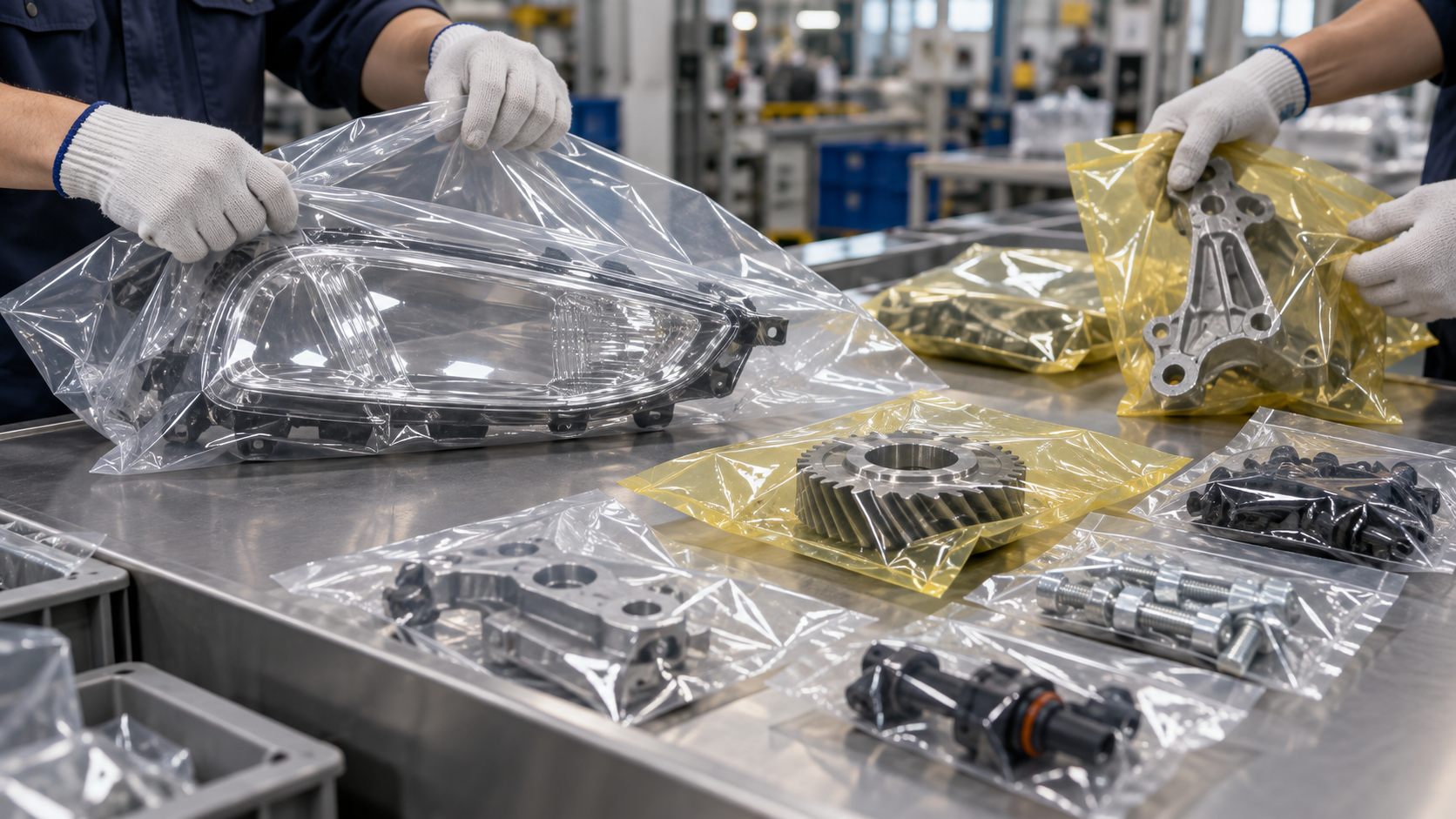
Automotive components create very different packaging requirements. A small sensor, cable assembly, gear, bearing, bracket, and heavy machined component may differ significantly in weight, geometry, surface condition, and corrosion risk.
For this reason, automotive parts packaging should not be specified only by bag dimensions. PE material, film thickness, puncture risk, corrosion protection, bag format, storage duration, and transportation conditions should all be considered.
Start With the Component Risk
Before selecting the packaging, identify:
- Component weight and dimensions
- Sharp corners or protrusions
- Metal type
- Oil or machining-fluid residues
- Corrosion sensitivity
- Storage duration
- Domestic or export transportation
- Handling and stacking conditions
A smooth lightweight component creates a very different requirement from a heavy gear or machined steel part with sharp edges.
Choosing the Right PE Material
HDPE
HDPE is relatively stiff and can be produced at lower gauges. It may be appropriate for lightweight components or inner packaging where puncture risk is low.
LDPE
LDPE is softer and more flexible and can be useful where conformability and relatively clear film appearance are desired.
LLDPE
For many automotive spare parts and metal components, LLDPE is often considered when greater toughness and puncture performance are required.
Commercial LLDPE grades are widely used for industrial films and heavy-duty packaging because they can provide a useful combination of toughness, tear resistance, puncture resistance, and processability.
For demanding sharp-edged components, metallocene-based formulations may also be considered after application testing.
When Is VCI Packaging Needed?
When a metal automotive component is at risk of corrosion during storage or transportation, VCI — Volatile Corrosion Inhibitor — packaging can be incorporated into the PE packaging system.
VCI materials release corrosion-inhibiting molecules into the enclosed package and help protect exposed metal surfaces.
Applications can include:
- Gears and bearings
- Shafts
- Machined steel components
- Brake or transmission parts
- Fasteners and hardware
- Long-term spare-parts inventory
- Export components
Automotive parts transported over longer distances or through humid environments may require more corrosion protection than parts moving through short domestic supply chains.
VCI works best when parts are clean, cool, and visibly dry before packaging. It does not remove standing water, and trapped moisture or condensation can increase corrosion risk.
The metal type must also be considered because VCI formulations can differ for ferrous, non-ferrous, and multi-metal assemblies.
What Film Thickness Should Be Used?
There is no universal micron specification for automotive parts.
As a practical starting point, Dynaplast’s current film-thickness guidance can be summarized as:
| Application | Initial Thickness Guide |
|---|---|
| Lightweight, smooth components | 20–40 µm HDPE or 40–60 µm LDPE/LLDPE |
| General automotive components | 60–100 µm LLDPE |
| Heavier components | 75–120 µm LLDPE |
| Relatively sharp-edged parts | 80–120 µm LLDPE |
| Heavy-duty parts / severe handling | 100–150+ µm PE |
These ranges are starting recommendations rather than universal standards. Dynaplast currently treats approximately 40 microns as the safer minimum starting point for general industrial LLDPE, while its published automotive-parts guidance places typical LLDPE applications around 60–100 microns.
Thickness should not be considered in isolation. Sharp components may benefit from improved resin selection, film formulation, bag design, or additional protection rather than simply increasing gauge.
Choosing the Packaging Format
Flat Bag
Suitable for small to medium components with relatively simple geometry.
Gusseted Bag
Useful for bulky or three-dimensional parts because additional folded material allows the bag to expand around the product.
Tubing / Roll Stock
Useful where different component lengths are packed and the customer prefers to cut and seal the film internally.
Liner / Cover
Suitable for bins, cartons, pallets, assemblies, or larger automotive components.
For VCI applications, package closure is important. A properly enclosed package helps maintain the protective environment; heat sealing provides an excellent closure, while tape, ties, or other methods may be suitable depending on the packaging design.
Conclusion
Effective automotive parts packaging combines PE material, film thickness, puncture risk, corrosion protection, dimensions, and packaging format.
Lightweight components may require relatively simple packaging, while heavy, sharp, or corrosion-sensitive metal parts require a more detailed specification.
PT Dynaplast Mandiri can help evaluate HDPE, LDPE or LLDPE selection, customized dimensions, gussets, film thickness, and VCI requirements according to the component and its distribution conditions. For new applications, a sample trial using the actual automotive part is recommended before the final production specification is approved.